Tuesday, January 26, 2016

Is it Racist to Criticize Islam?

Until I entered the arena of apologetics to Muslims, I could never have imagined that some people would consider criticism of ideas to be tantamount to racism. I quickly learned, however, that there are indeed some who see it as such.

One such individual, Paul Williams of BloggingTheology.net, is one of them. Recently, on Twitter, a discussion broke out between a friend of mine and Paul Williams on the identity of the suffering servant in Isaiah 53. I suggested to Paul Williams that we engage in a moderated debate on whether Isaiah 53 is Messianic. Among his reasons for declining my invitation, he tweeted this:

Racial abuse of Muslims... Seriously? Since when was Islam considered a race? And since when was the criticism of ideas tantamount to racism? "Racial abuse" is a serious charge, implying either physical or verbal assault.

It is certainly true that Williams and I part ways on many issues, including the justifiability, from the Qur'an and other Islamic sources, of atrocities committed by the Islamic State and other groups. This, however, is an academic difference of opinion on how to best interpret those sources. I hold no ill-feeling whatsoever towards Muslim people. In fact, my heart is filled with compassion for them, and I long for them to be saved by the same grace that saved me.

I of course recognise that, while the Islamic State represent a valid expression of Islam, they are not normative for all Muslims. Muslims are a very diverse group of people, and I have long recognized the folly of branding or stereotyping all Muslims in any particular way.

In refutation of Williams' false and defamatory allegation, my friend, Gunter, helpfully linked to a post of mine on Facebook from early December of 2015, in which I repudiated in the strongest of terms Christians who agreed with the anti-Muslim immigration policy promoted by Donald Trump:

It truly saddens me that such defamatory tactics are exercised all too commonly among many of the internet Muslim polemicists.

How Does A Muslim Concept of Scriptural Revelation Differ From A Christian Concept?

From time to time, I have had Muslims request to do a debate on the topic of "Which is the word of God -- the Qur'an or the Bible?" I have consistently turned down this topic for at least two very good reasons. The first is that the topic is too broad and unfocused for a single debate. The second is that Christians and Muslims have a very different understanding of what it means to be "the word of God". In such a discussion, therefore, the Christian and Muslim is likely to be talking past one another.

In Islam, the Qur'an is believed to be inscribed in a Tablet in Paradise (Surah 85:22). It was literally dictated to Muhammad over a 23 year time period by the angel Gabriel. In stark contrast, Christians do not subscribe to a dictation theory -- at least for the majority of the Bible. Rather, the Christian understands the Scriptures to be God-breathed (theopneustos, in Greek) (2 Timothy 3:16-17). As 2 Peter 1:20-21 says,
"...no prophecy of Scripture comes from someone's own interpretation. For no prophecy was ever produced by the will of man, but men spoke from God as they were carried along by the Holy Spirit."
The Bible was written over a timescale of roughly 1500 years, by as many as between 30 and 40 different authors. The nature of divine inspiration is such that the stylistic characteristics of the individual authors has been preserved, but nonetheless the Spirit of God has driven them to write the Scriptures that God willed that we should possess.

Some parts of Scripture do record the exact words of God. For example, the book of Malachi is entirely a report of the words of God as He speaks in judgement against the priests of Israel.

I spoke about this fundamental difference one time on ABN Sat's Trinity Channel. Wrenching my words out of context, internet Muslim polemicist Ijaz Ahmad (of the website "Calling Christians") put together a short video claiming that "Jonathan McLatchie rejects the Bible." Here it is below:


It was obvious from the context from which this clip was excerpted that I was talking about how Muslims and Christians have a rather different concept of Scripture and revelation. I was making the point that Christians do not understand the Bible as a whole to be literally the inscribed word of God in the way that Muslims do with respect to the Qur'an. This, however, didn't stop Ijaz from excerpting a clip and dishonestly entitling it "Jonathan McLatchie rejects the Bible". In the video, Ijaz also quoted Exodus 24:12 and 31:18, in which we are told that the ten commandments are inscribed by the finger of God. Ijaz claimed that I had thus made "a fundamental mistake about the Bible's Scriptural nature." I wondered whether Ijaz thought that Christians believed God to have inscribed the entire Bible on those tablets. I and others pointed out his error when the video first came out last September. But I note that Ijaz, as recently as January 14th on his blog, claimed that I "didn’t know God literally inscribed the ten commandments according to Exodus," linking to this video.

It seems that, often in Muslim polemical circles, there is little if any concept of being charitable in your interpretation of other's words. It is disappointing.

Monday, January 25, 2016

Does Jesus' Claim to be the Son of Man Affirm His Deity? Catching Yahya Snow in a Contradiction

I recently had some back and forth (see here and here) with Muslim YouTube polemicist Yahya Snow regarding Jesus' self-identification by the title "Son of Man", a clear reference back to Daniel 7:13-14 in which Daniel sees a vision of a divine-human figure. Yahya Snow insists that the Son of Man is a personification of the nation of Israel, and cannot possibly refer to a person who is God. As I mentioned previously, the Greek Septuagint translation tells us that the Son of Man receives latreuo from all nations. Latreuo is the very highest form of worship and religious service. In Yahya Snow's recent video on whether Jesus allowed His disciples to worship Him (which I addressed in my previous article here), he shows a clip of Ali Ataie talking about the two Greek words that are used for worship -- proskuneo and latreuo. Ataie concedes that latreuo is a form of worship reserved for God alone. Yet here is the problem: Jesus claimed to be the Son of Man, who, according to the Greek Septuagint translation of Daniel 7:14, receives latreuo. But Yahya insists that Jesus' claim to be the Son of Man is not a claim to deity. Yahya Snow thus appears to have been caught in a contradiction.

Did Jesus Allow His Disciples to Worship Him? A Reply to Zakir Hussein, Ali Ataie, and Yahya Snow

Yahya Snow, a notorious YouTube Muslim polemicist, has been putting out some commentary on my recent debate with Muslim Sheikh Inamullah Mumtaz. In a recent video, he took some issue with my comments regarding Thomas worshiping Jesus as Lord and God in John 20:28. The Greek reads, ἀπεκρίθη Θωμᾶς καὶ εἶπεν αὐτῷ Ὁ Κύριός μου καὶ ὁ Θεός μου, which, being translated, literally means "Answered Thomas and said to him, the Lord of me and the God of me!"

Watching the clip where I raised this text, I noticed that I had mistakenly said that the text of John 20 uses the Greek verb proskuneo (meaning, in a religious context, "to worship"). I was relying on my memory and I misremembered the text at this point. John 20 does not in fact use the word proskuneo. Proskuneo is used in relation to Jesus on various other occasions, and the disciples are in fact described as giving Jesus proskuneo in Luke 24. What makes this especially important is that we are told that, following Jesus' ascension into heaven, the disciples, "having worshiped" (Greek, proskynēsantes) him, "returned to Jerusalem with great joy" (Luke 24:52). Yahya Snow's video plays a clip in which Ali Ataie makes the assertion that proskuneo only implies that the disciples were kissing Jesus' hand out of reverence. While proskuneo can have those connotations, in a religious context, the verb always means to worship. The religious context of Luke 24:52 is very clear, since Jesus had already ascended into heaven. This, thus, refutes the supposition that they were merely kissing Jesus' hand out of reverence.

Yahya Snow also plays a clip of Muslim debater Zakir Hussein (arguably the best Muslim debater in the UK). He argues that the account in John 20 is in fact a fictional account invented wholesale by John (or whoever he takes the author of the fourth gospel to be). His reasoning is that Luke 24:36-49 reports Jesus as having appeared to "the eleven" who were all present together at the time (see verse 33). This, argues Hussein, doesn't allow for Thomas' absence from the group at the time of the appearance, nor a subsequent appearance to the disciples with Thomas present. Furthermore, John tells us that the appearance to the eleven with Thomas present occurred eight days later, whereas Luke seems to indicate that the ascension took place immediately after the appearance to the eleven. Luke 24:50-51 tell us,
"Then he led them out as far as Bethany, and lifting up his hands he blessed them. While he blessed them, he parted from them and was carried up into heaven."
One possible reply is that "the eleven" is being used as a figure of speech, much as "the twelve" is used in that way by Paul (see 1 Corinthians 15:5). I do not, however, find this approach to be the most convincing, since it seems to be rather ad hoc, and there is no additional evidence that Luke used the term "the eleven" in this way. It also would not explain the apparent immediacy of Jesus' ascension following the appearance to the eleven, allowing apparently no time for a subsequent appearance to the disciples with Thomas present.

The refutation to Zakir Hussein's objection can be found in the book of Acts (penned by the same author, Luke). Here is the prologue to the book of Acts:
"In the first book, O Theophilus, I have dealt with all that Jesus began to do and teach, until the day when he was taken up, after he had given commands through the Holy Spirit to the apostles whom he had chosen. He presented himself alive to them after his suffering by many proofs, appearing to them during forty days and speaking about the kingdom of God."
So, Luke understands Jesus to have been with the disciples for forty days following his resurrection. Luke's language implies that he appeared to them multiple times over the course of forty days. Thus, the only conclusion that one can draw is that Luke, in chapter 24, telescopes the post-resurrection appearances of Jesus, collapsing them all into one. This, thus, resolves the apparent discrepancy between Luke and John.

Wednesday, January 20, 2016

Did Jesus Claim to be the Divine Son of God?


Here is another one of my interviews on the One Minute Apologist, in which I briefly discuss whether the historical Jesus self-identified as the divine Son of God.

For more of my interviews on this and other podcasts, as well as for some of my talks and debates, check out, and subscribe to, my YouTube channel.

Saturday, January 16, 2016

Pastor Saeed Abedini Has Been Freed by Iran

Christian pastor Saeed Abedini (along with several others) has been freed as part of a prisoner exchange with Iran.
CNN—Iran has freed four prisoners from the United States, including Washington Post journalist Jason Rezaian, Iran's semi-official FARS news agency reported Saturday, citing Tehran's prosecutor.

According to FARS, Iran freed Rezaian, Marine veteran Amir Hekmati and Christian pastor Saeed Abedini, who had been held on various charges. FARS identified the fourth prisoner freed as Nosratollah Khosrawi. Details of Khosrawi's case were not immediately known.

The release is part of a prisoner swap deal in which the United States reportedly freed seven Iranian-Americans held on charges related to sanctions against Iran, FARS said. The news agency had previously said the U.S. was to release six prisoners.

"Based on an approval of the Supreme National Security Council (SNSC) and the general interests of the Islamic Republic, four Iranian prisoners with dual-nationality were freed today within the framework of a prisoner swap deal," FARS quoted the office of the Tehran prosecutor as saying. (Continue Reading.)

Thursday, January 14, 2016

Adoni vs. Adonai, and Its Implications in Psalm 110

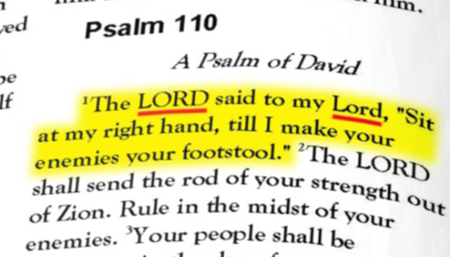
In my opening statement in my recent debate with Sheikh Inamullah Mumtaz, I briefly mentioned in passing Psalm 110, in which Yahweh says to one identified (in verse 1) as Adoni (the possessive form of Adon, which is translated "lord"), "Sit at My Right Hand, until I make your enemies a footstool for your feet." Here is the full Psalm:
"The Lord says to my Lord: “Sit at my right hand, until I make your enemies your footstool.” The Lord sends forth from Zion your mighty scepter. Rule in the midst of your enemies! Your people will offer themselves freely on the day of your power, in holy garments; from the womb of the morning, the dew of your youth will be yours. The Lord has sworn and will not change his mind, “You are a priest forever after the order of Melchizedek.” The Lord is at your right hand; he will shatter kings on the day of his wrath. He will execute judgment among the nations, filling them with corpses; he will shatter chiefs over the wide earth. He will drink from the brook by the way; therefore he will lift up his head."
In order to save time, I simplified by argument somewhat, and said that the one to whom Yahweh is speaking in verse 1 is identified as Adonai. I was not at all wrong in saying this, and I was prepared to clarify my exegesis should I have been challenged on it. As an informed Unitarian, Muslim, or orthodox Jew will tell you, technically verse 1 of Psalm 110 says "Yahweh says to Adoni..." Adoni is not exclusively a divine title, whereas Adonai is. The two words are almost identical in the Hebrew. The only distinguishing feature is the difference in Masoretic "vowel pointing" associated with the two words -- something which developed centuries after Christ.

Sometimes it is claimed that Adoni never refers to God, but this is incorrect. For example, the word Adoni is used for the Angel of Yahweh in Judges 6:13, and the Angel of Yahweh is clearly identified as none other than God Himself (see my article here for a defence of this).

So what are my grounds for interpreting verse 1 as referring to Adonai, even though the Hebrew text says Adoni? The key is verses 5-7:
"The Lord is at your right hand; he will shatter kings on the day of his wrath. He will execute judgement among the nations, filling them with corpses; he will shatter chiefs over the wide earth. He will drink from the brook by the way; therefore he will lift up his head."
Verse 5 does indeed say "Adonai", and it clearly interprets verse 1, since Adonai is said to be seated at Yahweh's right hand. Verses 5-7, moreover, can hardly be applied to anyone but God.

Finally, David should never be inferior to any of his descendants. Therefore, for him to call any of them 'Lord' raises the question as to what sort of 'Lord' that could possibly be.

How Does Jesus Fulfil Old Testament Scripture?


Here is my latest interview on the One Minute Apologist. For more of my interviews on this and other podcasts, as well as my debates and talks, check out my YouTube Channel.

Where Does Allah Say "I am God, Worship Me" in the Qur'an?

It has come to my attention that a comment I made during the Q&A period in my recent debate with Inamullah Mumtaz is not accurate. A caller had asked whether God says in the Qur'an "I am God, worship me" with those exact words. The point, of course, is that there are multiple ways in which a concept can be conveyed, and Jesus communicates his deity on numerous occasions without using the exact words "I am God, worship me" as so many Muslims unreasonably require. I answered that Allah does not say "I am God, worship me" with that exact sequence of words (although the concept is clearly communicated throughout the Qur'an). It was brought to my attention that Surah 20:14 comes almost as close as you can get to this sequence of words:
"Indeed, I am Allah. There is no deity except Me, so worship Me and establish prayer for My remembrance."
My thanks to the Muslims who brought this to my attention.

The point remains the same, however: Jesus can communicate His deity without necessarily using a precise sequence of words, such as "I am God, worship me."

Monday, January 11, 2016

Live Debate: Today at 1pm EST


Later today, at 1pm EST (6pm GMT), I am going to be engaging in a live debate on ABN Sat's Trinity Channel. My opponent will be Sheikh Inamullah Mumtaz, and our topic will be "Is Jesus God?" See the poster above for further details. Please remember me in your prayers, watch the debate live, and call in with your questions!

For online live-stream, go to http://www.trinitychannel.com.

Friday, January 8, 2016

Jihad Comes to Philadelphia

Edward Archer recently ambushed Officer Jesse Hartnett. After being apprehended, Archer proclaimed his allegiance to ISIS and his desire to promote sharia through jihad. Yet Philadelphia Mayor Jim Kenney insists that the attack had nothing to do with Islam. Can we take the mayor's comments seriously?

What is the Gospel?


Here is my latest interview on the One Minute Apologist, in which Pastor Bobby Conway asks me to explain the gospel in a nutshell.

For more of my interviews on the One Minute Apologist and other programs, as well as talks and debates, check out my YouTube channel here.

Advice to Young Aspiring Apologists

David Wood recently posted an excellent video featuring a series of short interview clips with various apologists (Douglas Groothuis, Gary Habermas, Craig Hazen, Mike Licona, Nabeel Qureshi, Mary Jo Sharp, and Frank Turek) on advice to future apologists. As one who is of the younger generation myself (I am almost 27), and who has been active in the public apologetics arena from relatively young (from around 20 years of age) I have some experience to speak of when it comes to being a young defender of the Christian faith.
In this article, I want to address those who are young, perhaps in their late teens or in their 20’s, and who aspire to do public work in apologetics. In particular, I want to reflect on my observations over the past six or seven years of involvement in apologetics and what lessons I have learned in the process — sometimes, unfortunately, the hard way.

'To Distinguish or Not To Distinguish?' That is the Question: A Problem With the Distinction of the Prophets in the Qur'an and Jesus

When it comes to the subject of the prophets in Islam, Muslims will claim that they respect all the prophets equally, and that they make no distinction among them. This is based on the following passages from the Qur'an below. Bold lettering is mine.

Thursday, January 7, 2016

Is the Son of Man the Nation of Israel? A Reply to Yahya Snow

Muslim polemicist Yahya Snow has published a response to my recent article regarding the Son of Man (apparently without linking to the article he is addressing). It is curious that Yahya Snow exemplifies the very same attitude that I often observe among the "new atheist" community that I engage with. He can't imagine that someone who is as informed and rational as him could possibly disagree reasonably. Thus, those with whom he disagrees must have been subject to indoctrination, or some other impediment to clear thinking. As I noted previously, he had earlier stated that the reason for my "superficial and misleading spin" on Daniel 7:13-14 was because I "may well have been indoctrinated...in [my] youth." This time, he has another reason why I don't see things the way he does: Pride. He writes,
"I’d like you to make a concerted and conscious effort to put pride and any other hindrance to objective analysis to one side and reflect on the points in the video as well as the supplementary material in this blog post." 
Further,
Being led by emotion and pride in order to defend an idea (Trinity) which is described as idolatry by Jewish rabbis is really playing with fire -- regardless of who you are [...] Please look into it sans pride and the emotional baggage surrounding it.
To Yahya, it is inconceivable that someone could have taken the time to watch his video and read his blog post and yet fail to be persuaded by his argumentation. When I recently suggested a debate on the identity of the angel of the LORD in the Old Testament, Yahya was sure that this must be the reason I don't see things the way he does. He said,
"I'd rather encourage you to reflect further on this issue as opposed to jumping into a debate to defend your personal view on the angel of the Lord. Acting upon the impulse of pride can blind one from seeing the the [sic] truth."
 Now, let's turn to the issue at hand.

Tuesday, January 5, 2016

Debate: "Is Jesus God?" Jonathan McLatchie vs. Inamullah Mumtaz, January 11th 2016


Here is the promo for a forthcoming debate between myself and Sheikh Inamullah Mumtaz on ABN Sat's Trinity Channel on Monday, January 11th, 2016 @ 1pm EST / 6pm GMT. Topic: "Is Jesus God?" Be sure to tune in!

Saturday, January 2, 2016

Who is the Son of Man of Daniel 7:13-14?

Jesus’ favourite self-designation in the gospels is the title “Son of Man”. In the narrative of Jesus’ trial, Jesus connects this title with the image of “coming with the clouds of heaven”, thus drawing our attention to the prophetic text of Daniel 7:13-14:
“I saw in the night visions, and behold, with the clouds of heaven there came one like a son of man, and he came to the Ancient of Days and was presented before him. And to him was given dominion and glory and a kingdom, that all peoples, nations, and languages should serve him; his dominion is an everlasting dominion, which shall not pass away, and his kingdom one that shall not be destroyed.”
A typical Jewish interpretation of this text in Daniel is that the Son of Man is actually a personification of the nation of Israel. Jewish apologists draw support for this interpretation from the interpretation of Daniel’s entire vision given in verses 15-22 of the same chapter, and in particular verses 18, 22 and 27: “But in the end, the holy people of the Most High will be given the kingdom, and they will rule forever and ever… until the Ancient of Days—the Most High—came and judged in favor of his holy people. Then the time arrived for the holy people to take over the kingdom.… Then the sovereignty, power, and greatness of all the kingdoms under heaven will be given to the holy people of the Most High. His kingdom will last forever, and all rulers will serve and obey him.”” Thus, it is argued, the Son of Man in verses 13-14 actually refers to the “saints of the most high”, not the Messiah. This is the argument presented in a recent video by Muslim YouTube polemicist Yahya Snow claiming to offer a refutation of my claim that the "Son of Man" was used by Jesus as a divine title.

The clip that Yahya Snow played of me was from an old radio debate of mine, at a point at which I was asked to give an example where Jesus self-identified as God. I cited Jesus' self-designation as "Son of Man" and its clear ties to Daniel 7:13-14. Here, it is less important how the text was originally intended by its author to be interpreted and more important how Jesus Himself understood it and his intent in applying the title to Himself. Clearly, Jesus did not understand the title "Son of Man" in Daniel as a reference to the nation of Israel (unless one is seriously going to contend that Jesus considered Himself to be the whole nation of Israel). Jesus clearly understood the title as a title of deity.