
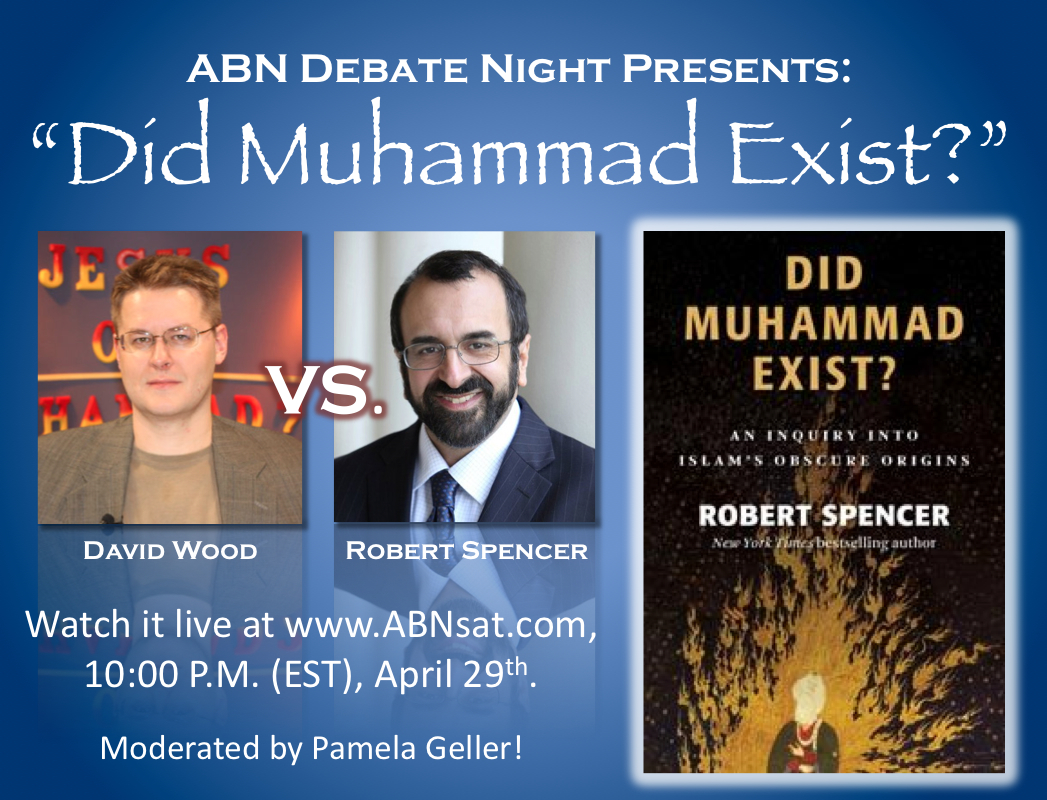
If you don't get ABN via satellite, you can watch the debate live at 8:00 P.M. (EST) here.

Then the high priest stood up and said to Jesus, "Are you not going to answer? What is this testimony that these men are bringing against you?" But Jesus remained silent. The high priest said to him, "I charge you under oath by the living God: Tell us if you are the Christ, the Son of God." "Yes, it is as you say," Jesus replied. "But I say to all of you: In the future you will see the Son of Man sitting at the right hand of the Mighty One and coming on the clouds of heaven." Then the high priest tore his clothes and said, "He has spoken blasphemy! Why do we need any more witnesses? Look, now you have heard the blasphemy. What do you think?" "He is worthy of death," they answered. (Matthew 26:62-66, NIV)In a recent debate I was told that Jesus never said, "I am God worship me". At that time I did not answer with the above verses but now I think I should have. The reason is that in these verses Jesus proclaims his divinity and that all people will worship him.
Kiss the Son, lest he be angry and you be destroyed in your way, for his wrath can flare up in a moment. Blessed are all who take refuge in him. (Psalm 2:12, NIV)The Jewish leaders understand what Jesus has said and see it as blasphemy.
In my vision at night I looked, and there before me was one like a son of man, coming with the clouds of heaven. He approached the Ancient of Days and was led into his presence. He was given authority, glory and sovereign power; all peoples, nations and men of every language worshiped him. His dominion is an everlasting dominion that will not pass away, and his kingdom is one that will never be destroyed. (Daniel 7:13-14, NIV)So what is Jesus saying at his trial? What is it that ultimately gets him crucified? It is his claim to be Son of Psalm 2 and 110 who is at the right hand of God and is to be worshipped; it is to be the divine man of Daniel 7 who is to be worshipped. The Jewish leaders again understand exactly what he is saying and call it blasphemy. So Jesus actually does say, "I am God worship me"; he just uses the language of the prophets to say it.
Qur’an 5:47—“Let the people of the Gospel judge by what Allah hath revealed therein. If any do fail to judge by (the light of) what Allah hath revealed, they are (no better than) those who rebel.”Thus, when Christians present their beliefs, it makes sense for Muslims to ask, “Could you show us where the Bible says that?” Christians should therefore be eager to present evidence from the Gospel, because Muslims cannot condemn us for doing what the Qur’an commands. Indeed, since the Qur’an affirms not only the Gospel, but also the Torah (Qur’an 5:43), Muslims cannot ignore what the Bible says without thereby rebelling against Islam.
Isaiah 44:6—Thus says the LORD, the King of Israel and his Redeemer, the LORD of hosts: “I am the first and I am the last, and there is no God besides Me.”When “LORD” is written in all capitals in the Old Testament, the term refers to Yahweh, the creator of the universe. Since both the Bible and the Qur’an give the title “the First and the Last” to God, it should be quite shocking for Muslims to open the New Testament and read Revelation 1:17-18, where Jesus says:
“Do not be afraid; I am the first and the last, and the living One; and I was dead, and behold, I am alive forevermore, and I have the keys of death and of Hades.”Would a mere prophet claim to be the “First and the Last”?
Mark 2:5-7—And Jesus seeing their faith said to the paralytic, “Son, your sins are forgiven.” But some of the scribes were sitting there and reasoning in their hearts, “Why does this man speak that way? He is blaspheming; who can forgive sins but God alone?”The scribes correctly recognized that only God can forgive sins. Yet Jesus (who referred to himself as the “Son of Man”), knowing their thoughts, replied that “the Son of Man has authority on earth to forgive sins” (Mark 2:10). He then healed the paralytic, proving that his claims were true.
John 8:12—“I am the Light of the world; he who follows Me will not walk in the darkness, but will have the Light of life.”THE TRUTH
John 14:6—Jesus said to him, “I am the way, and the truth, and the life; no one comes to the Father but through Me.”How can a mere human being claim to be “The Truth”?
Qur’an 22:56-57—The kingdom on that day shall be Allah’s; He will judge between them; so those who believe and do good will be in gardens of bliss. And (as for) those who disbelieve in and reject Our communications, these it is who shall have a disgraceful chastisement.So why, we may wonder, would Jesus tell his followers that he will be the final judge of all people?
Matthew 25:31-32—“But when the Son of Man comes in His glory, and all the angels with Him, then He will sit on His glorious throne. All the nations will be gathered before Him; and He will separate them from one another, as the shepherd separates the sheep from the goats.”Jesus goes on to say that he will admit certain people to heaven and cast others into hell. Isn’t this something only God can do?
1 Samuel 2:6—The LORD kills and makes alive; He brings down to Sheol and raises up.Since God will raise the dead at the resurrection, why would a mere prophet tell his followers that he will resurrect the dead?
Qur’an 22:7—Allah will resurrect those who are in the graves.
John 5:25-29—“Truly, truly, I say to you, an hour is coming and now is, when the dead will hear the voice of the Son of God, and those who hear will live. For just as the Father has life in Himself, even so He gave to the Son also to have life in Himself; and He gave Him authority to execute judgment, because He is the Son of Man. Do not marvel at this; for an hour is coming, in which all who are in the tombs will hear His voice, and will come forth; those who did the good deeds to a resurrection of life, those who committed the evil deeds to a resurrection of judgment.”GOD’S GLORY
John 11:25—Jesus said to her, “I am the resurrection and the life; he who believes in Me will live even if he dies.”
Isaiah 42:8—“I am the LORD, that is My name; I will not give My glory to another.” (Cf. Isaiah 48:11—“My glory I will not give to another.”)Yet Jesus claimed, not only that he would be glorified with the Father, but that he had glory with the Father before the world was created!
John 17:5—“Now, Father, glorify Me together with Yourself, with the glory which I had with You before the world was.”How can anyone see this as anything other than a claim to deity?
John 5:21-23—“For just as the Father raises the dead and gives them life, even so the Son also gives life to whom He wishes. For not even the Father judges anyone, but He has given all judgment to the Son, so that all will honor the Son even as they honor the Father. He who does not honor the Son does not honor the Father who sent Him.”Since one of the ways we honor the Father is by worshiping him, it should come as no surprise that Jesus’ followers worshiped him on numerous occasions. Indeed, the Gospel tells us that Jesus was worshiped throughout his life: shortly after his birth (Matthew 2:11), during his ministry (Matthew 14:33, John 9:38), after his resurrection (Matthew 28:17), and after his ascension to heaven (Luke 24:52). Jesus’ disciple Thomas even addressed him as “my Lord and my God” (John 20:28).
SWEDEN--A 19-year-old woman was found stabbed to death in her apartment in southern Sweden on Monday night and police have since arrested her younger brother on suspicion of murder.
The woman was found dead just before midnight on Monday in her apartment in Landskrona in southern Sweden, with multiple stab wounds to her body.
“It’s horrible in there,” said a police member to the Aftonbladet newspaper, reporting that blood traces ran from the room to the elevator.
The woman, who had previously lived in a foster home after escaping from family problems, had celebrated her 19th birthday in the apartment recently.
She reportedly moved to the apartment to build a new life for herself after having been plagued by family troubles.
Police arrested the woman’s 16-year-old brother after finding him outside the apartment, according to the paper.
It is alleged that the boy killed his sister for disgracing their family by having several boyfriends and trying to build a life for herself away from home.
"He thought that she brought shame to the family," a friend of the victim told the paper. (Read more.)
In this post I wish to add another element to the discussion of the preservation of the Qur'an. I have searched around but cannot find this issue being discussed. It may well have been but I cannot find it. This issue is, are the chains of narration for the Qur'an reliable?
Normally when Christians and Muslims discuss the reliability of the Qur'an hadiths are quoted to show that the idea that there is one version of the Qur'an and that it has simply been memorised and passed down to us has no historical basis in Islamic history. Here is a summary of the references that are often used.
1. Muhammad did not collect the quran, forgot parts and had seven different versions.
Sahih al-Bukhari: vol. 6, bk. 61, no. 556, Khan
Sahih al-Bukhari: vol. 6, bk. 61, no. 513, Khan
Sunan Abu Dawud: bk. 3, no. 1015, Hasan
Sahih al-Bukhari: vol. 6, bk. 61, no. 514, Khan
Sahih al-Bukhari: vol. 6, bk. 61, no. 509, Khan
Sunan al-Tirmithi: 3103, Kreidly
2. The Qur'an was collected and memorised by his companions but they memorised it differently.
Sahih al-Bukhari: vol. 6, bk. 60, no. 468, Khan
Sahih al-Bukhari: vol. 6, bk. 60, no. 467, Khan
Sahih Muslim: bk. 4, no. 1799-1802, Siddique
Sahih al-Bukhari: vol. 6, bk. 61, no. 527
The famous librarian, al-Nadim, in the year 375 A.H./987 A.D. listed a whole series of books dealing with these different collections and the differences between them. He records that Abdullah ibn Mas'ud's version of the Qur'an had 110-112 suras while Ubayy ibn Ka'b's collection had 116, that these collections had a different ordering of the suras and that there were variants in the verses. See, Al-Nadim, The Fihrist of al-Nadim - A Tenth Century survey of Muslim Culture, New York: Columbia University Press, pp. pp. 58-61 and 79.
And these different versions of the Qur'an were used by the early Islamic scholars. For example, when Al-Tabari (d. 310 AH/923 AD) quotes the Qur'an in his writings, he not only quotes from Uthman's version but also from Abdullah ibn Mas'ud's version. See, The History of Al-Tabari, SUNY, vol. I, p. 353, vol. II, pp. 68, 108, 109, vol. III, p. 174.
Arthur Jeffery (Materials for the History of the Text of the Qur'an) surveyed these Islamic scholars and identified 15 primary different collections of the Qur'an with a whole range of variants.
In the 1980's many ancient Qur'ans were discovered in San`a'. Some of these have the sura order that was credited to Abdullah ibn Masud and others. (Gerd-R Puin, Observations on the Early Qur'an Manuscripts in San`a'. In "The Qur'an as Text", ed. Stefan Wild, Leiden: Brill, 1996. pp. 110-111)
These different collections caused a major problem for early Islam and so,
3. Uthman made one version of the Qur'an and burned the other collections.
Sahih al-Bukhari: vol. 6, bk. 61, no. 510, Khan
Sunan al-Tirmithi: 3104, Kreidly
4. Not all the companions accepted Uthman's version of the Qur'an. In particular Abdullah ibn Mas'ud did not accept it.
Sahih Muslim: bk. 31, no. 6022, Siddiqui
Sunan al-Tirmithi: 3104, Kreidly
Ibn sa'd vol. 2 p. 444, Haq
However, Uthman's version won the day.
I am sure many of us are familar with this story, but the reply I have been told by Muslims is that even if this is the case it does not matter because the version from Uthman is an authentic Qur'an from Muhammad. The existence of all these other versions does not take away from the fact that the Uthman version is true. This is based on the belief that this version of the Qur'an can be authenticated right back to Muhammad through its chain of narrators, and this is what I want to consider, is the chain of narrators for the Qur'an reliable?
The Qur'an is like the Hadith in that each Arabic version (qira'at) of the Qur'an has a chain of narrators which authenticates it. For a chain to be deemed reliable (saheeh) it must be complete, contain reliable narrators and be historically possible. Here are the chains for the two most common versions of the Qur'an.
THE QUR’AN ACCORDING TO IMAM HAFS (The most common Arabic version of the Qur'an used today.)
The reading of Aasim Ibn Abî an-Najûd (Aasim Ibn Bahdalah Ibn Abî an-Najûd): He died in the year 127 or 128 H.
He reported from Abû Abd ar-Rahmân as-Solammî and Zirr Ibn Hubaysh.
Abû Abd ar-Rahmân reported from Uthmân and Alî Ibn Abî Tâlib and 'Ubayy (Ibn Ka’b) and Zayd (Ibn Thâbit).
And Zirr reported from Ibn Mas’ud.
THE QUR’AN ACCORDING TO IMAM WARSH (The Arabic version used in North Africa.)
Nâfic died in the year 169 H.
He reported from Yazîd Ibn al-Qaqâc and Abd ar-Rahmân Ibn Hurmuz al-'Araj and Muslim Ibn Jundub al-Hudhalî and Yazîd Ibn Român and Shaybah Ibn Nisâ'.
All of them reported from Abû Hurayrah and Ibn Abbâs and Abdallâh Ibn 'Ayyâsh Ibn Abî Rabî'ah al-Makhzûmî and the last three reported from Ubayy Ibn Ka’b from the Prophet(P).
http ://www.islamic-awareness.org/Quran/Text/Qiraat/hafs.html#4
Notice who the final links in the chains are. For the Hafs Qur'an it includes Ubayy Ibn Ka'b and Abdullah Ibn Masud, and for the Warsh Qur'an it is Ubayy Ibn Ka’b. Now this is historically impossible according to Islamic sources because there is ample evidence to show that Ubayy Ibn Ka'b and Abdullah Ibn Mas'ud had quite different collections to Uthman's version and that Abdullah Ibn Mas'ud refused to accept Uthman's version. Thus Ubayy Ibn Ka'b and Abdullah Ibn Mas'ud should not be part of the chain for Uthman's Qur'an. Therefore on Islamic historical grounds the chain of narrators for the Hafs and Warsh versions are both weak/da'eef; they are certainly not authentic/saheeh as there are valid Islamic historical reasons to doubt them.
Some Reflections
1. Surely we should expect the chain of narrators for the Qur'an to be the best example of an Islamic authentic/saheeh chain? But it is not.
2. I am not saying that the modern Qur'an is not Uthman's version, but I am saying that Muslims cannot use these chains of narrators to prove this.
3. What evidence do Muslims have to prove that these Qur'ans are Uthmans's versions?
4. One of the reasons that Muslim leaders reject the Bible is that Christians do not provide a comprehensive chain of narrators for it. They feel that the Qur'an is superior to the Bible because it has a better chain of narrators to authenticate it. But as we have seen this chain of narrators for the Qur'an is doubtful and so this attitude of superiority is not warranted.
5. How do we confirm that a book has been faithfully transmitted? Certainly chains of narrators are useful but they are only one aspect of history. All of history needs to be considered as well as examining the ancient manuscripts. This is what Christians do with the Bible. They consult all of the history, examine the ancient manuscripts and look at the scriptural quotes from the earlier Christian scholars. This is what Muslims need to do too if they wish to show that the Qur'an has been perfectly preserved.
What do people think?
LAHORE: A madrassah student in Lahore has been tortured to death by a qari (Quran teacher) on Sunday. The Punjab Chief Minister Shahbaz Sharif has taken notice of the incident and sought a report from the Capital City Police Officer (CCPO).
According to the FIR filed by the victim’s father Mohammad Shafiq at the Shadbagh police station, his 12 year old son Mohammad Jamil was studying the Quran at Madrassah Aziziya from Nazim-e-Ahla (Mohtmam) Qari Muhammad Jameel and an unknown teacher for at least four months.
Both the qari and teacher escaped before the police raided the madrassah. The madrassah has been sealed while a search operation is under way for the escapees.
The FIR further stated that, a few days ago, Jamil complained to his mother about severe abdominal pain, caused by the qari’s alleged torture, after which he was taken to four different private and government hospitals for treatment but eventually succumbed to the injuries, breathing his last late Sunday night. (Read more.)
As many as 100,000 women in Britain have undergone female genital mutilations with medics in the UK offering to carry out the illegal procedure on girls as young as 10, it has been reported.
Investigators from The Sunday Times said they secretly filmed a doctor, dentist and alternative medicine practitioner who were allegedly willing to perform circumcisions or arrange for the operation to be carried out. The doctor and dentist deny any wrongdoing.
The practice, which involves the surgical removal of external genitalia and in some cases the stitching of the vaginal opening, is illegal in Britain and carries up to a 14 year prison sentence. It is also against the law to arrange FGM.
Known as "cutting", the procedure is traditionally carried out for cultural reasons and is widespread across Africa.
It is thought to be needed as proof of a girl's "purity" for when she marries, but victims are rarely given anaesthetic and frequently suffer long-term damage and pain.
Research suggests that every year up to 6,000 girls in London are at risk of the potentially fatal procedure, and more than 22,000 in the UK as a whole.
The Metropolitan Police said since 2008, it had received 166 reports of people who fear they are at risk of FGM.
It is the same story for all 43 forces across England and Wales with no convictions for the offence ever taking place, according to The Sunday Times.
The newspaper added that only two doctors have been struck off by The General Medical Council since 1980.
According to Forward, a charity which campaigners against FGM, an estimated 100,000 women in the UK have undergone mutilation. (Read more.)
UNITED KINGDOM--A group of Muslim men who abducted and raped two teenage girls as part of their Eid celebrations laughed in court yesterday as they were jailed for a total of 38 years.
The girls, aged 15 and 16, were lured miles from their home to a dingy hostel.
In a horrifying weekend-long ordeal, they were plied with alcohol and repeatedly raped by two men, Shamrez Rashid and Amar Hussain, before being offered to a number of others who also ‘used them for sex’.
The 16-year old was forced to have sex six times with four different men. The younger victim was raped by one man and then sexually assaulted by another.
One defendant, Rashid, 20, was said to have claimed the girls had enjoyed the sex, which he said had taken place as they celebrated the Muslim festival of Eid. ‘It was Eid,’ he said. ‘We treated them as our guests. OK, so they gave us [sex] but we were buying them food and drink. ‘They could have anything they wanted. They enjoyed it.’
His accomplice Amar Hussain, 22, claimed the girls were ‘slags’.
But Judge Melbourne Inman QC said the girls had still been children at the time of the offences. He said it was quite obvious they had been frightened of the men, but this had had ‘no effect at all’ on their attackers’ behaviour. ‘They were still children and still living with their families,’ Judge Inman said. ‘In a civilised society, such people should be helped. You all abused them. ‘They were extremely vulnerable and you took advantage of that.’
The five defendants laughed and smirked as the horrifying details of their offences were described in court yesterday.
Rashid – who had already been found guilty of two rapes, an attempted rape, child abduction and an attempted sexual assault – grinned, laughed and made gun gestures in the dock. His supporters in the public gallery hurled abuse at the judge as he passed sentence later.
The court heard how Rashid and Hussain drove the girls from their home in Telford in Shropshire to a Birmingham probation hostel on the evening of Saturday November 28 2009. They took them to an unfamiliar environment so they ‘would be disorientated and reliant on them,’ prosecutors said.
After raping the girls, they ‘in effect offered them up to their friends, introducing a string of young men into the house’. Over the following 36 hours, the girls were subjected to almost constant abuse, despite begging their attackers to stop.
The 16-year-old was left with bruising all over her face and neck after she was forced to perform a sex act on Hussain. She was then forced to have sex with Rashid and a third man, Adil Saleem, while others watched.
The court heard how she held on to a doorframe to try to stop her attacker dragging her into a bedroom, but was pushed inside and the door locked behind her. She was warned that her attackers were in a gang known as the B9 Crew, and that ‘when someone pressed charges against them, they went to their mother’s house, put a gun to her face and broke her jaw’.
The girls eventually ran from the hostel and called the emergency services from a pay phone. (Read more.)
Fathers shall not be put to death for their children, nor children put to death for their fathers; each is to die for his own sin. (Deuteronomy 24:16, NIV)
The soul who sins is the one who will die. The son will not share the guilt of the father, nor will the father share the guilt of the son. The righteousness of the righteous man will be credited to him, and the wickedness of the wicked will be charged against him. (Ezekiel 18:20, NIV)
(H)e must bring as his offering for the sin he committed a female goat without defect. He is to lay his hand on the head of the sin offering and slaughter it at the place of the burnt offering. Then the priest is to take some of the blood with his finger and put it on the horns of the altar of burnt offering and pour out the rest of the blood at the base of the altar. He shall remove all the fat, just as the fat is removed from the fellowship offering, and the priest shall burn it on the altar as an aroma pleasing to the LORD. In this way the priest will make atonement for him, and he will be forgiven. (Leviticus 4:28-31, NIV)
For the life of a creature is in the blood , and I have given it to you to make atonement for yourselves on the altar; it is the blood that makes atonement for one's life. (Leviticus 17:11, NIV)
(The priests) will put the most holy offerings (there) - the grain offerings, the sin offerings and the guilt offerings - for the place is holy. (Ezekiel 42:13, NIV)


FLORIDA--While support for Israel remains strong among most Americans and their representatives in Congress, American college campuses have become a hotbed of anti-Zionist propaganda that can sometime blur the line between inflammatory political arguments and outright Jew-hatred. The latest example of just how close to that line Israel’s foes go comes from Florida Atlantic University, where Students for Justice in Palestine posted mock eviction notices on the doors of more than 200 dorm rooms at the school.
The leaflet seeks to inculcate the idea that Israel is a brutal oppressor that deliberately murdered an American supporter of the Palestinians. These charges are a malicious distortion of the facts and are part of a hateful campaign whose purpose is to delegitimize Israel. Israel’s critics have a right to express their opinions, but by pasting these fake evictions on the doors of a dorm with what one supposes is a considerable Jewish population, the action raises questions about whether the intent was to intimidate Jews as well as demonizing the Jewish state.
Compounding the problem is the fact that the notices were actually approved by the school’s housing department, one of whose employees accompanied the anti-Israel activists as they put up their work. Subsequently, FAU disavowed this move but as with past incidents at other universities, it looks as if the school has not considered whether they have facilitated a hate crime against Jews. (Read more.)
Allison McCarthy is a freelance writer whose work has appeared in publications such as Bitch, Ms. (blog), AlterNet, Girlistic, Global Comment, ColorsNW, The Baltimore Review, Ariel Gore's Literary Kitchen, and Hoax, as well as in the anthologies Robot Hearts: Twisted and True Tales of Seeking Love in the Digital Age (Pinchback Press) and Dear Sister: Letters to Survivors of Sexual Violence (forthcoming). Her guest column forGOOD magazine was selected as an Editor's Favorite for 2011. She is currently a graduate student in the Master of Professional Writing program at Chatham University and lives in Maryland.
In Memory of Shaima Alawadi
Shaima Alawadi
thirty-two years old,
housewife in El Cajon
a California mother of five
found by her teenage daughter
beaten unconscious
drowned in blood
with a note:
“Go back to your own country. You’re a terrorist.”
They left a note on your house the week before
You dismissed it as a childish prank
You did not call the police
Could you even have imagined
a world of kicked-in doors and
tire-iron swipes to your precious head?
Her death is an act of terrorism
Violence against women of color is an act of terrorism
Violence at the hands of white supremacy is an act of terrorism
Shaima,
your name means good-natured
I imagine you walking in California sunshine
holding your babies
laughing with your daughter
Your killers took nothing from your home
except what could not be replaced
There are no answers for Fatima
as she clutches tissue
sunglasses hiding her tears
speechless at her mother’s innocence
no comfort, no justice
She calls the killers
animals without a God
(Source)
New post on Muslim Debate Initiative |  |
|
Unsubscribe or change your email settings at Manage Subscriptions. Trouble clicking? Copy and paste this URL into your browser: |
The prophetically announced, apostolically confirmed, historically verified reality of Christ’s crucifixion, something virtually uncontested by the vast majority of scholars, has long been a point of embarrassment for Muslims, as has Christ’s triumph over death and the grave, particularly since the man they wish was a prophet, Muhammad, who admittedly has been under the power of death for 1,400 years, is widely believed to have denied that the crucifixion (and by implication the resurrection) even took place:
And because of their saying (in boast), "We killed Messiah Iesa (Jesus), son of Maryam (Mary), the Messenger of Allah," - but they killed him not, nor crucified him, but the resemblance of Iesa (Jesus) was put over another man (and they killed that man), and those who differ therein are full of doubts. They have no (certain) knowledge, they follow nothing but conjecture. For surely; they killed him not (i.e. Iesa (Jesus), son of Maryam (Mary) ): S. 4:157, Hilali-Khan
Since in the nature of the case truth must cohere with itself and correspond to the facts, this of necessity meant that a systematic altering of many other things taught by the prophets and apostles was in order for Muhammad. Not only did Muhammad’s denial of the crucifixion logically dictate that he would have to teach a very different view of salvation than that shadowed forth in the ceremonial law of Moses, of which Christ is authoritatively declared to be the reality, substance, and fulfillment according to the apostolic writings (q.v. the Book of Hebrews); it also necessitated teaching a very different view of God, who in this scheme becomes the arch-deceiver of history.
And they cheated/deceived and God cheated/deceived, and God (is) THE BEST (of) the cheaters/deceivers. S. 3:54, Ahmed Ali
And when those who disbelieved deceive/scheme at you to affix/affirm you, or kill you, or bring you out, and they scheme/deceive, and God deceives/schemes and God (is) BEST (of) the deceivers/schemers. S. 8:30, Ahmed Ali
In this coup, God becomes the paradigmatic deceiver, and Satan’s deception becomes merely imitative, being modeled on Allah’s own pattern of deception, a habit Allah is said to have modeled forth and to have had some practice in long before the first century.
He [i.e. Satan] said: Now, because Thou [i.e. Allah] hast sent me astray, verily I shall lurk in ambush for them on Thy Right Path. S. 7:16, Pickthall
[Iblis (Satan)] said: "O my Lord! Because you misled me (aghwaytanee), I shall indeed adorn the path of error for them (mankind) on the earth, and I shall mislead (walaoghwiyannahum) them all. S. 15:39, Hilali-Khan
This is very different from what Jesus taught:
Jesus said to them, “If God were your Father, you would love Me, for I proceeded forth and have come from God, for I have not even come on My own initiative, but He sent Me. Why do you not understand what I am saying? It is because you cannot hear My word. You are of your father the devil, and you want to do the desires of your father. He was a murderer FROM THE BEGINNING, and does not stand in the truth because there is no truth in him. Whenever he speaks a lie, he speaks from HIS OWN NATURE, for he is a liar and THE FATHER OF LIES. But because I speak the truth, you do not believe Me. Which one of you convicts Me of sin? If I speak truth, why do you not believe Me? He who is of God hears the words of God; for this reason you do not hear them, because you are not of God.” John 8:42-47, NASB
Unsurprisingly Muslims have put forth a lot of effort to cover Islam’s shame when it comes to these things. One such Muslim is Paul Williams of the Muslim Debate Initiative. Today Paul has argued that the prophecy of Psalm 22:16, which has traditionally been understood to foreshadow the crucifixion, is not well-founded, resting as it (allegedly) does on later manuscripts that are not supported by the reading found in the original Hebrew text. According to Paul, the post-Christian Jewish study Bible gives the more accurate, and no doubt “unbiased,” reading. In contrast to the King James version, which says,
For dogs have compassed me:
the assembly of the wicked have inclosed me:
they PIERCED my hands and my feet
The Jewish Study Bible offers the following translation of the supposedly earlier and more reliable reading:
Dogs surround me;
a pack of evil ones closes in on me,
like lions [they maul] my hands and feet
…since the King James version was made over 400 years ago numerous manuscripts of the Hebrew bible have been discovered taking us ever CLOSER to the ORIGINAL text. In a number of significant places our translations have been revised in light of these new discoveries, Psalm 22 being a good example. This has meant that a number of traditional proof texts employed by Christians as prophecies of Jesus are no longer credible… (emphasis mine)
Ironically enough, Williams’ usual targets are Christian fundamentalists; yet it is just the kind of superficial acquaintance with and presentation of the facts on full display in Williams' argumentation that is supposed to characterize fundamentalists.
Michael Rydelnik, a Jewish convert to Christianity who is currently professor of Jewish Studies at what Williams would call a “fundamentalist” school, i.e. Moody Bible Institute, is better acquainted with the facts and makes Williams look like an obscurantist of the highest order:
The Masoretic Text reads ka’ari, (“as a lion”) and the Septuagint reads oruxan, from the verb orusso, “to dig/excavate” or “to perforate/pierce,”41 apparently a translation of the Hebrew k’ru (“they pierced”).42 Thus, the verse in the Masoretic Text reads, “For dogs have surrounded me; a gang of evildoers has closed in on me; as a lion . . . my hands and my feet.” However, the LXX, Syriac, and the Vulgate read, “For dogs have surrounded me; a gang of evildoers has closed in on me; they pierced my hands and my feet.”
Plainly, the Masoretic Text rendering avoids the Christological implications of predicting the crucifixion, thereby taking the less messianic rendering and making it more acceptable to Judaism.43 The primary arguments for taking the Masoretic Text as the correct reading is that preference should always be given to the Masoretic Text and to the harder reading. The absence of the verb, making the phrase elliptical, yields not only the harder reading but a virtually UNINTELLIGIBLE one. On the other hand, the Septuagintal reading has THE OLDER SUPPORT and MAKES GRAMMATICAL SENSE within the literary context.44
In the final analysis, it seems that the Septuagintal reading should be preferred for several reasons. First, although the Masoretic Text has the harder reading, there is a difference between a harder reading and an impossible one. One would have to assume incoherence on the part of the author, which is far more than the principle of taking the harder reading requires. As Peter Craigie has noted, the Masoretic Text reading “presents numerous problems and can scarcely be correct.”45 Second, defining the harder reading depends on the audience reading it. For a Masorete, “they pierced my hands and my feet,” a seeming prediction of the Messiah’s crucifixion, would certainly have been the harder reading. Third, the LXX reading fits the literary context, makes grammatical sense, and is supported by the other versions (and even some Masoretic traditions). Perhaps most important, in 1997, the translation of a textual discovery from Nahal Hever in the Judean Wilderness brought strong support to the Septuagintal reading.
The discovery of a fragment of the book of Psalms, dated between AD 50-68,46 contains Ps 22:17[Eng. 16] and reads, k’ru (“they pierced”).47 . . . Thus THE OLDEST EXTANT Hebrew manuscript of Ps 22:17 reinforces the Septuagintal, Syriac, and Vulgate readings, supporting the translation “They pierced my hands and my feet.” (Michael Rydelnik, The Messianic Hope: Is the Hebrew Bible Really Messianic?, NAC Studies in Bible & Theology (Nashville, Tennessee: B&H Publishing, 2020), p. 44-46) (Italics original; bold and capital emphasis mine)
42 It is uncertain whether the verb rendered by the LXX was כָּאֲרִ or כרך, both of which occur in a few Masoretic mss. R. L. Harris took it from כרך, giving the meaning as “bore, dig, hew (meaning dubious).” He explains that it “occurs only in Ps 22:16 [H 17],” and “may be an hapax ka’ar. The meaning ‘dig, wound, pierce’ would derive from the context and LXX.
43 The MT reading is also supported by the editors of the NET Bible. Although they recognize that the reading is “grammatically awkward” and characterized by “broken syntax,” their apparent commitment to the MT above all motivates them to retain the Masoretic reading and to argue that “it is better not to interpret this particular verse as referring to Jesus’ crucifixion in a specific or direct way.” The NET Bible (Richardson, TX: Biblical Studies Press, 1997), 924n20.
44 For a thorough analysis of the text-critical problem and a compelling argument for the LXX reading, see C. R. Gren, “Piercing the Ambiguities of Psalm 22:16 and the Messiah’s Mission,” JETS 48 (2005): 284-99.
45 P. C. Craigie, Psalms 1-50, WBC (Waco, TX: Word, 1983), 196.
46 P. Flint, “Biblical Scrolls from Nahal Hever and ‘Wadi Seiyal’: Introduction,” in Miscellaneous Texts from the Judaean Desert, ed. J. Charlesworth, N. Cohen, H. Cotton, and E. Eshel, DJD 38 (Oxford: Clarendon, 2000), 143.
47 M. Abegg Jr., P. Flint, E. Ulrich, The Dead Sea Scrolls Bible (New York: HarperSanFrancisco, 1999), 519; J. VanderKam and P. Flint, The Meaning of the Dead Sea Scrolls (New York: HarperSanFrancisco, 2002), 125. The latter states, “Among the Dead Sea Scrolls, the reading in question is not preserved at Qumran, but in the Psalms scroll from Nahal Hever (5/6HevPs), which is textually very close to the Masoretic Text. In line 12 of column 10 we read: ‘They have pierced my hands and feet’! For the crucial word … is grammatically difficult; but it is clearly a verb, not a noun and means they have bored or they have dug or they have pierced.”
The facts, then, pierce right through Williams’ claims to scholarship and expose the fundamentalist beneath. However, don’t be too hard on Paul, the possibility remains that it was his “god” who made him think he was a scholar. This wouldn’t be the first time the one who admits to being the arch-deceiver of history has led one of his "creatures" astray.
-------
Some other articles dealing with this in more detail can be found here:
Addressing Muslim Polemicist Abdullah Kunde's Biblical Distortions Pt. 1
Psalm 22:16 - "like a lion" or "they pierced"?
12. Objections to 2nd and 22nd Psalm
Psalm 22, Questions and Comments
Piercing the Ambiguities of Psalm 22:16 and the Messiah's Mission


